EDSGN 468 Engineering Design and Analysis with CAD Assignment Help

- EDSGN 468 Assignment Requirements in Penn State CAD Work
- Solid Model Representation in Assignment Tasks
- Design Intent and Parametric Associativity
- CAD Communication Through Drawings and Portfolios
- Software Tools Used in EDSGN 468 Assignments
- SolidWorks, AutoCAD, and CATIA Assignment Workflows
- File Formats, Imported Models, and Revision Tasks
- Common Challenges in EDSGN 468 CAD Assignments
- Assembly Fit, Form, and Function Issues
- FEA and Analysis-Ready Model Problems
- CNC and Prototyping Preparation Mistakes
- How Expert Assignment Support Helps EDSGN 468 Students
EDSGN 468 Engineering Design and Analysis with CAD is a Penn State course focused on using computer-aided design for engineering design, analysis, and technical communication. As listed on the official Penn State course page for EDSGN 468 Engineering Design and Analysis with CAD, the course covers CAD methods, solid-model representation, design intent, assemblies, analysis, technical drawings, file formats, and design communication. Because of this, assignments in this course require careful modeling steps, accurate dimensions, clean feature planning, and proper use of CAD software. Students may need to create 3D parts, build assemblies, apply parametric relationships, prepare drawing sheets, work with finite element analysis, and manage files for prototyping or CNC use. Many students look for 3D Modeling Assignment Help when they face sketch errors, broken references, missing mates, or unclear drawing requirements. At SolidWorksAssignmentHelp.com, we support Penn State students with course-based CAD assignment guidance related to SolidWorks, AutoCAD, CATIA, assemblies, technical drawings, and design projects. Students who search for do my solidworks project support can get help with task review, model correction, file setup, and project-based CAD assistance aligned with EDSGN 468 requirements.
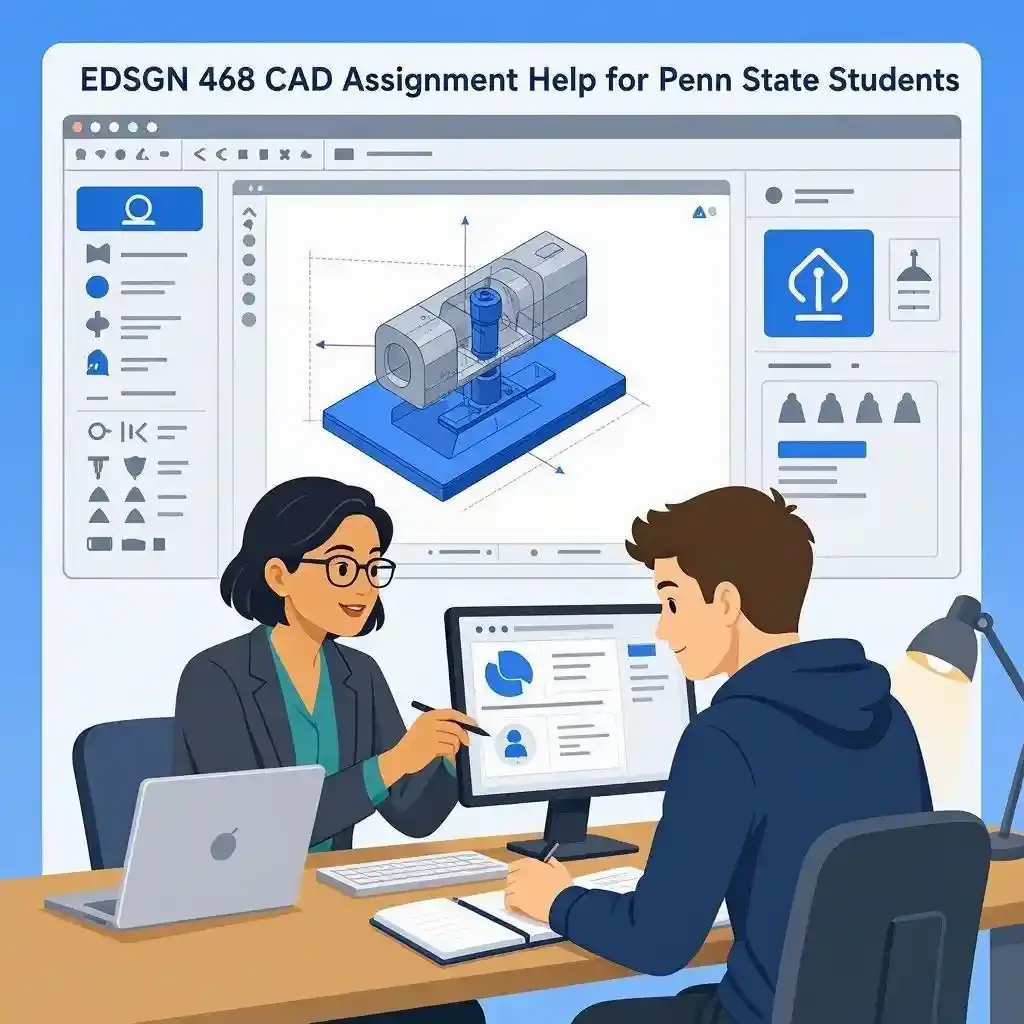
EDSGN 468 Assignment Requirements in Penn State CAD Work
EDSGN 468 assignments are based on the use of CAD for engineering design and analysis. Students are expected to create models that are accurate, editable, and useful for design decisions. These tasks often include part modeling, assembly development, drawing sheet creation, file management, and design presentation.
The course also includes work related to design intent and parametric associativity. This means the CAD model should respond correctly when dimensions, features, or linked parts are changed. In assignment work, this can be difficult because poor sketch planning or weak feature order can create errors later in the file.
Students may also need to prepare design projects, tutorials, quizzes, laboratory tasks, and online portfolio work. Each assignment type needs a different CAD output. A tutorial may focus on one tool, while a project may require complete models, drawings, assemblies, and supporting design files.
Solid Model Representation in Assignment Tasks
Solid-model representation is a major part of EDSGN 468 assignment work. Students need to create models that show the correct shape, size, and engineering purpose of a part. This involves more than making a model look correct on screen. The model should also be built using proper features, dimensions, references, and relationships.
In SolidWorks assignments, students may use tools such as extrude, cut, revolve, sweep, loft, fillet, chamfer, mirror, shell, and pattern. These tools must be applied in the correct order. If a feature is built from the wrong sketch plane or depends on a weak reference, the model may fail when edited.
EDSGN 468 students may also work with AutoCAD or CATIA, depending on the software package used in the course section. Each software has its own modeling process. AutoCAD tasks may involve precise drafting and drawing control, while CATIA tasks may include part design, assembly structure, and more complex CAD workflows.
Design Intent and Parametric Associativity
Design intent is one of the most important parts of EDSGN 468 CAD assignments. It shows whether the student has built the model in a way that supports future design changes. A model with strong design intent will update properly when a dimension changes. A model with weak design intent may break when edited.
Parametric associativity is closely linked to this requirement. Students need to connect dimensions, sketches, parts, and assemblies in a logical way. For example, a hole should remain centered if the base plate changes size. A repeated pattern should update when the number of instances changes. An assembly relationship should stay stable when part dimensions are adjusted.
Many assignment errors happen because students create models quickly without planning the design structure. This can lead to under-defined sketches, lost references, failed rebuilds, broken mates, or drawing views that do not update correctly. EDSGN 468 assignment help can support students with checking model logic, repairing broken features, and improving CAD file structure.
CAD Communication Through Drawings and Portfolios
EDSGN 468 also focuses on using CAD to communicate engineering designs. This means students may need to prepare technical drawings, views, sections, annotations, dimensions, and design documentation. A strong CAD model still needs clear drawing sheets to show important design details.
Technical drawing assignments may include front views, top views, side views, isometric views, section views, detail views, exploded views, bill of materials, and title blocks. Students must place dimensions correctly and make the drawing easy to read. Poor drawing layout can make a good model look incomplete or unclear.
The course also includes online design portfolio work. For this part, students may need to present CAD models, screenshots, renders, design descriptions, drawings, and project progress in a clear format. EDSGN 468 portfolio assignments require organized files and clean visual presentation because the portfolio shows how CAD was used during the design process.
Software Tools Used in EDSGN 468 Assignments
EDSGN 468 may involve different CAD packages, including SolidWorks, AutoCAD, and CATIA. This makes the course practical but also demanding. Students need to follow the workflow of the software used in their section while still meeting the engineering design goals of the assignment.
Each CAD package has different tools, commands, interface settings, file formats, and modeling rules. A student who is comfortable with one software may still face problems when the assignment requires another platform. This is why software-specific support is useful for EDSGN 468 assignment work.
The assignment requirements may also change based on the CAD package. A SolidWorks task may focus on parametric part design and assemblies. An AutoCAD task may focus on clean 2D drafting and drawing control. A CATIA task may involve advanced product structure, part design, and assembly development.
SolidWorks, AutoCAD, and CATIA Assignment Workflows
SolidWorks assignments in EDSGN 468 may include sketch-based modeling, feature creation, part editing, assembly mates, exploded views, configurations, design tables, drawings, and simulation-related file setup. Students need to keep the model tree clean and ensure each sketch is properly defined.
AutoCAD assignments may involve accurate 2D geometry, layers, blocks, line weights, dimension styles, annotations, layouts, and plotting settings. These tasks require precision because the final drawing must communicate engineering information clearly. A wrong scale, missing layer, or weak dimension style can affect the assignment quality.
CATIA assignments may involve part design, product structure, assembly constraints, surfaces, drafting, and file management. CATIA can be difficult for students who are new to its interface and workbench system. EDSGN 468 students using CATIA may need support with setting up parts, managing references, and preparing files for correct submission.
File Formats, Imported Models, and Revision Tasks
EDSGN 468 also includes work with native and non-native file formats. Students may need to open, edit, export, or convert CAD files. Common file issues can appear when a file is moved between software packages or when a model is imported from another source.
Imported models may not have a feature tree. They may contain surface errors, missing faces, scaling problems, or geometry that is difficult to edit. Students may need to clean the file, repair geometry, simplify the model, or rebuild parts from the imported shape.
Revision tasks are also common in CAD assignments. Students may receive feedback and then need to correct dimensions, update parts, fix assemblies, revise drawings, or export a new file version. EDSGN 468 assignment help can support these tasks by reviewing the file, identifying the issue, and helping students prepare a cleaner final submission.
Common Challenges in EDSGN 468 CAD Assignments
EDSGN 468 assignments can be difficult because the course combines design, modeling, analysis, manufacturing preparation, and technical communication. Students are not only asked to make CAD files. They also need to use CAD as part of the engineering design process.
A common challenge is that one mistake can create several later problems. A weak sketch can affect a feature. A wrong feature can affect an assembly. A broken assembly can affect the drawing. A poor drawing can affect the final design presentation. This is why EDSGN 468 CAD assignments require careful checking at every stage.
Students also face deadline pressure. CAD projects often take more time than expected because errors may appear near the final stage. A file may look complete, but the drawing may not update correctly, the assembly may show interference, or the exported file may not open in the required format.
Assembly Fit, Form, and Function Issues
Assemblies are an important part of EDSGN 468 assignment work. Students may need to combine multiple parts and check how they fit together. This includes placing parts correctly, adding mates, checking clearances, and confirming that the assembly follows the intended design function.
Fit problems happen when parts overlap, holes do not align, clearances are too small, or components are placed in the wrong position. Form problems happen when the shape does not match the required design. Function problems happen when the parts do not move, connect, or support each other as intended.
Assembly assignment help can support students with mate setup, interference checks, exploded views, component alignment, and assembly drawing preparation. This is useful when a student has modeled the parts but cannot make the full assembly work correctly.
FEA and Analysis-Ready Model Problems
The official EDSGN 468 description includes finite element analysis as part of the CAD-based design and analysis work. This means some assignments may require students to prepare models for analysis or use CAD tools to check design performance.
FEA-related assignments can be challenging because the model must be suitable for analysis. A design created only for appearance may not work well for simulation. Students may need to simplify geometry, check material settings, define loads, apply constraints, and review the analysis setup.
Common problems include poor mesh quality, missing constraints, unrealistic loads, wrong material selection, and geometry that is too complex for the analysis. EDSGN 468 support can help students prepare CAD files for analysis-related assignment tasks and review whether the model setup matches the required design activity.
CNC and Prototyping Preparation Mistakes
EDSGN 468 also connects CAD work with prototyping and CNC preparation. Students may need to prepare files that can support manufacturing-related tasks. This requires attention to geometry, file type, dimensions, tolerances, and model cleanliness.
A model made for screen viewing may not be ready for prototyping. It may contain thin features, open surfaces, wrong units, duplicate geometry, or missing details. These issues can create problems when exporting the file for CNC, stereolithography, or other prototyping methods.
Students working on these assignments may need help checking model readiness, correcting file errors, confirming dimensions, and exporting the correct format. CAD design project support can help students prepare better files for prototyping-related EDSGN 468 tasks.
How Expert Assignment Support Helps EDSGN 468 Students
EDSGN 468 Engineering Design and Analysis with CAD requires accurate work across modeling, assemblies, drawings, analysis, file formats, and design communication. Students must manage software tools and engineering design requirements at the same time. This makes the course assignment-heavy and detail-focused.
SolidWorksAssignmentHelp.com provides support for EDSGN 468 assignments related to SolidWorks, AutoCAD, CATIA, 3D modeling, technical drawing, CAD design projects, assemblies, file correction, and portfolio preparation. Students can share their assignment brief, rubric, screenshots, sketches, CAD files, and deadline so the task can be reviewed properly.
Our experts can help with part modeling, assembly checking, drawing sheet setup, feature correction, sketch repair, file conversion, imported model cleanup, FEA-ready model review, and design portfolio organization. The support is based on the actual CAD areas covered in EDSGN 468, so students receive help that matches the course requirements.
This type of assignment support is useful when students are stuck with broken references, unstable assemblies, unclear drawing requirements, file format issues, or urgent CAD project deadlines. EDSGN 468 requires clean design work, accurate CAD files, and clear design communication. With expert CAD assignment support, students can manage complex tasks more confidently and prepare better course-related submissions.