What Students Can Expect from ENGR 3735 SolidWorks for Industrial Design
.webp)
- ENGR 3735 Assignments Focused on Engineering Graphics and Design Documentation
- Orthographic Drawing Assignments in ENGR 3735
- Isometric Modeling and Visualization Projects
- Technical Drawing Documentation Requirements
- SolidWorks Part Modeling Assignments and Feature-Based Design Projects
- Parametric Modeling Assignment Challenges
- Advanced Feature Creation and Complex Geometry Assignments
- Manufacturing-Oriented Assignments in ENGR 3735
- Tolerancing and Dimensional Control Assignments
- Assembly Modeling and Component Relationship Projects
- CNC and Manufacturing Preparation Coursework
- Grading Criteria Commonly Used in ENGR 3735 Assignments
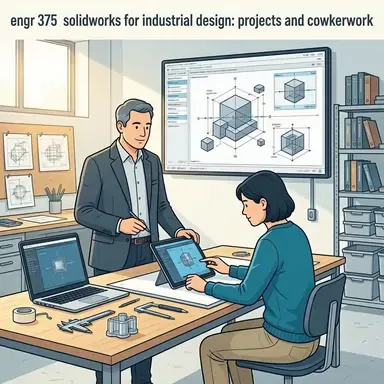
Students enrolled in ENGR 3735 – SolidWorks for Industrial Design complete a wide range of assignment-based projects that require the practical application of SolidWorks tools, engineering graphics principles, technical drawing standards, and industrial design methodologies. Coursework is heavily focused on producing professional CAD deliverables, including part models, assemblies, engineering drawings, design documentation, and manufacturing-oriented project files. Many students seek SolidWorks Parametric Modeling Help because assignments demand more than simply creating 3D models; they require proper design intent, feature organization, dimensional accuracy, and compliance with industry-standard drafting practices. Unlike theory-based engineering subjects, ENGR 3735 evaluates students through hands-on SolidWorks submissions that demonstrate technical proficiency and professional design workflows. Assignments often begin with sketch creation and feature-based modeling exercises before progressing to advanced projects involving assemblies, tolerancing, design revisions, rendering tasks, and manufacturing preparation. Students are expected to submit SolidWorks part files (.SLDPRT), assembly files (.SLDASM), drawing files (.SLDDRW), PDF drawing packages, and project documentation. As project complexity increases, many students search for guidance such as do my SolidWorks project assistance to better understand modeling requirements, improve submission quality, and successfully meet assignment grading criteria while managing demanding coursework deadlines.
ENGR 3735 Assignments Focused on Engineering Graphics and Design Documentation
Orthographic Drawing Assignments in ENGR 3735
Orthographic projection assignments require students to transform three-dimensional industrial design concepts into professional engineering drawings. These assignments assess a student's ability to communicate design information accurately using front, top, side, auxiliary, section, and detail views.
Many coursework exercises require the preparation of complete drawing sheets containing dimensions, centerlines, hidden lines, annotations, title blocks, and manufacturing notes. Students are often asked to generate drawing packages from SolidWorks models while ensuring compliance with accepted engineering graphics standards.
Instructors typically evaluate the accuracy of projections, dimension placement, drawing organization, annotation clarity, and overall presentation quality. Even minor drafting mistakes can result in substantial grade reductions because technical drawings serve as manufacturing instructions for the designed product.
Advanced assignments may require students to prepare multi-sheet drawing packages that include exploded views, assembly drawings, component details, and production documentation. These tasks help students develop the technical communication skills expected in professional industrial design environments.
Isometric Modeling and Visualization Projects
Isometric modeling assignments focus on developing three-dimensional visualization skills through SolidWorks part creation and product representation. Students are often provided with engineering drawings, conceptual sketches, or dimensional specifications and asked to produce accurate digital models.
Typical assignment deliverables include consumer product designs, industrial equipment components, packaging concepts, ergonomic products, and mechanical parts. Faculty members assess model accuracy, geometric consistency, feature selection, and adherence to assignment requirements.
Many projects require students to demonstrate proper use of SolidWorks sketching tools, reference geometry, feature operations, and design intent methodologies. Assignments frequently become more challenging as models incorporate curved surfaces, complex transitions, and aesthetic design elements commonly found in industrial design projects.
Visualization tasks may also require rendered outputs that communicate material appearance, product functionality, and overall design intent. Students are expected to use SolidWorks display settings and visualization tools effectively to produce professional presentation materials.
Technical Drawing Documentation Requirements
Technical documentation assignments require students to convert SolidWorks models into professional engineering drawing packages suitable for manufacturing and design communication.
Common assignment requirements include:
- Dimensioned drawings
- Section views
- Auxiliary views
- Detail views
- Tolerance specifications
- Surface finish information
- Material callouts
- Revision tables
- Assembly annotations
Students frequently discover that creating accurate models is only one portion of the assignment. Significant effort is also required to organize drawing layouts, select appropriate views, apply dimensions correctly, and ensure readability.
ENGR 3735 grading criteria often place considerable emphasis on documentation quality because industrial designers must communicate design intent effectively to manufacturers, engineers, and production teams.
SolidWorks Part Modeling Assignments and Feature-Based Design Projects
Parametric Modeling Assignment Challenges
Parametric modeling forms the foundation of many ENGR 3735 assignments. Students are expected to create intelligent models that maintain design flexibility through properly defined relationships, constraints, and dimensions.
Assignments often involve:
- Sketch relations
- Geometric constraints
- Design tables
- Configurations
- Equation-driven dimensions
- Parent-child feature relationships
A common challenge involves creating models that can accommodate design changes without generating rebuild errors. Many students focus solely on producing the required geometry and overlook the importance of establishing robust design intent.
Faculty members often assess feature tree organization, modeling efficiency, and the ability of the model to support future modifications. Assignments requiring multiple design revisions particularly emphasize the importance of clean parametric structures.
Students who understand how SolidWorks manages dependencies and feature relationships generally perform better on assignments involving iterative product development.
Advanced Feature Creation and Complex Geometry Assignments
As the semester progresses, students encounter assignments that require advanced feature creation techniques. These projects move beyond basic extrusions and cuts and introduce more sophisticated modeling approaches.
Assignments commonly involve:
- Sweeps
- Lofts
- Boundary features
- Surface modeling
- Shell operations
- Draft features
- Pattern tools
- Multi-body design techniques
Industrial design projects frequently require the creation of ergonomic shapes, consumer product housings, and visually refined components that cannot be modeled using simple features alone.
Students often spend considerable time troubleshooting failed features, repairing sketch geometry, and refining surface transitions. Assignment grading generally reflects both the final appearance of the model and the efficiency of the modeling strategy used to create it.
Advanced geometry projects help students develop the problem-solving skills necessary for professional CAD environments where complex designs are commonplace.
Manufacturing-Oriented Assignments in ENGR 3735
Tolerancing and Dimensional Control Assignments
Tolerancing assignments introduce students to manufacturing considerations that directly affect product quality and functionality. These projects require students to move beyond nominal dimensions and consider acceptable variations that occur during production.
Assignments frequently include:
- Linear tolerances
- Angular tolerances
- Fit analysis
- Clearance calculations
- Functional dimensioning
- Manufacturing variation studies
Students are often required to justify tolerance selections based on product functionality and manufacturing feasibility. Assignments may compare alternative tolerance schemes and evaluate their impact on production costs and assembly performance.
Faculty members assess whether dimensions and tolerances support both product functionality and realistic manufacturing practices.
Assembly Modeling and Component Relationship Projects
Assembly assignments are among the most comprehensive projects in ENGR 3735. Students must combine multiple components into functional systems while ensuring proper relationships between parts.
Typical assignment deliverables include:
- Assembly models
- Mate definitions
- Motion studies
- Interference analysis
- Exploded views
- Bills of Materials (BOM)
- Assembly drawings
These projects frequently reveal design flaws that are not apparent when parts are modeled individually. Students must analyze component interactions, resolve conflicts, and refine designs based on assembly performance.
Assembly assignments often represent a substantial percentage of overall coursework grades because they integrate multiple SolidWorks competencies within a single project.
CNC and Manufacturing Preparation Coursework
ENGR 3735 assignments also expose students to manufacturing preparation concepts that bridge the gap between digital design and physical production.
Students may be asked to evaluate:
- CNC machining feasibility
- Production constraints
- Material removal considerations
- Manufacturing workflows
- Design-for-manufacturing principles
- Toolpath-related concepts
Assignments often require students to analyze whether a design can be produced efficiently using standard manufacturing processes. Components that appear visually attractive in CAD software may require significant redesign before they become practical for production.
These projects encourage students to think like industrial designers who must balance aesthetics, functionality, and manufacturability within the same design solution.
Grading Criteria Commonly Used in ENGR 3735 Assignments
ENGR 3735 assignments are commonly evaluated using detailed grading rubrics that assess both technical accuracy and design methodology. Instructors frequently allocate marks across multiple performance categories rather than evaluating only the final model.
Typical grading criteria include:
- Sketch quality and completeness
- Proper use of constraints and relations
- Feature selection and organization
- Parametric design intent
- Model accuracy
- Drawing documentation quality
- Dimensioning practices
- Assembly functionality
- Tolerance application
- Manufacturing considerations
- Professional presentation standards
Many students lose marks because they focus exclusively on creating the required geometry while neglecting documentation quality, feature organization, or design intent implementation. Strong assignment submissions generally demonstrate a structured workflow, professional presentation, and a clear understanding of industrial design principles.
At SolidWorks Assignment Help, our experts provide assistance with ENGR 3735 coursework involving engineering graphics, orthographic projections, part modeling, assemblies, tolerancing, technical drawings, manufacturing documentation, rendering projects, and advanced SolidWorks assignments. Our specialists understand the specific coursework requirements associated with industrial design CAD projects and help students produce accurate, well-documented submissions that align with university assessment standards.